
Candy Insights & Industry News - ATIQ Food Co., Ltd.
INDUSTRY INSIGHTS & BLOG

Candy Innovation & Global Trends

Explore expert guides, manufacturing breakthroughs, and market updates from ATIQ Food Co., Ltd.

0%

The 2026 wholesale market is moving beyond novelty snacks. Buyers now want reliable texture, transparent sourcing, and measurable shelf stability. Freeze Dried Crunchy Puffs fit this shift because they offer light weight, intense flavor, and a distinctive crisp bite.

MarketsandMarkets valued the global freeze-dried food market at approximately USD 2.7 billion in 2024. Its report projects growth to USD 4.2 billion by 2029, representing a 9.4% compound annual growth rate (Freeze-Dried Food Market, MarketsandMarkets, 2024). This broader category does not isolate crunchy puffs. That limitation matters. Still, it indicates expanding commercial interest in freeze-dried formats.

Dr. M. K. Sablani, a food-processing researcher at Washington State University, describes freeze-drying as “an energy-intensive process.” His observation should influence wholesale decisions, not just sustainability discussions. Suppliers must examine water activity, expansion uniformity, breakage rates, and packaging performance. A puff may look impressive in a sample box, then soften during shipment. That happens.

This guide will compare leading 2026 Freeze Dried Crunchy Puffs for wholesale applications. It will consider ingredient quality, production consistency, private-label flexibility, minimum order quantities, certificates of analysis, and allergen controls. Texture will receive special attention. Buyers should test puffs after storage, transport, and repeated package opening.

The category still lacks fully standardized reporting. Therefore, rankings should remain practical rather than absolute. A lower-cost product may deliver weaker crunch. A premium product may create excessive waste. Careful sampling remains essential.
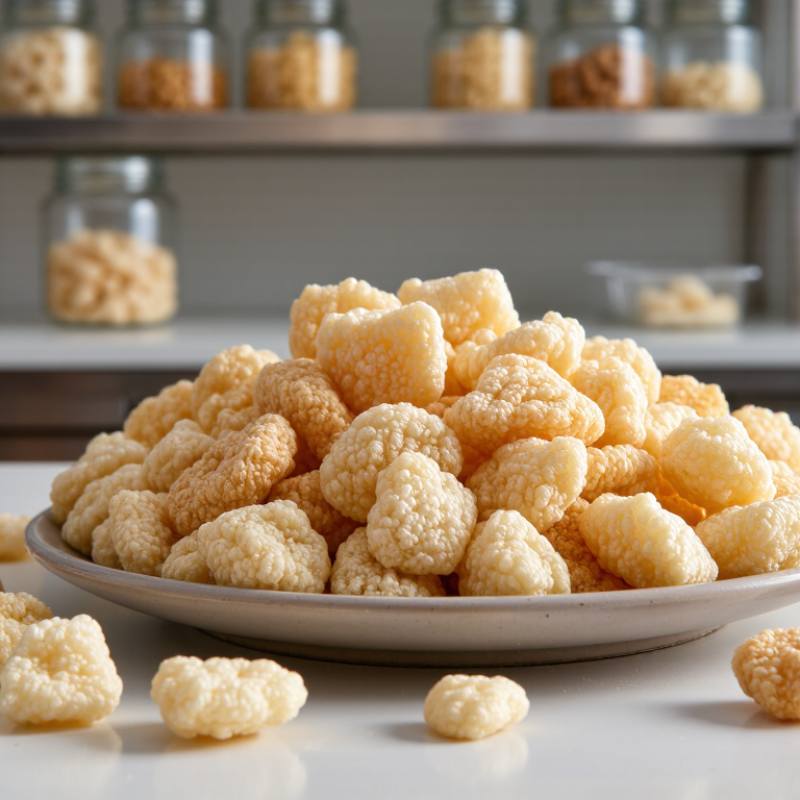
2026 Best Freeze Dried Crunchy Puffs for Wholesale?

Freeze-Drying Basics: How Moisture Below 5% Creates Crunchy Puffs

2026 Best Freeze Dried Crunchy Puffs for Wholesale?

Freeze-drying begins with a clean, uniform product and rapid freezing. Ice crystals form inside the food, then a vacuum removes them through sublimation. The solid ice changes directly into vapor. This preserves the puff’s open structure.

Moisture below 5% usually creates a crisp, brittle bite. It also reduces the soft texture caused by remaining water. However, moisture percentage alone does not guarantee quality. Water activity, measured with a calibrated meter, helps confirm storage stability. A puff can test dry yet lose crunch after absorbing humid air.

Production experience shows that thickness, sugar content, and freezing speed affect the final texture. Thin pieces often dry faster. Uneven pieces may leave a soft center. That is a problem.

For wholesale orders, quality checks should include moisture testing, water activity readings, weight consistency, and package seal inspection. After drying, puffs need moisture-barrier packaging with controlled handling. Opening a tray in a humid room can soften the product within minutes. I have found that small packaging delays matter more than expected. This deserves regular review.

A practical target is crisp texture, low moisture, and stable performance during transport. Still, the ideal result varies by ingredient. More testing may be needed before setting one universal specification. Sampling from different production batches can reveal changes that a single laboratory result misses.

Food Safety Screening: Apply FDA’s 0.85 Water-Activity Threshold

2026 Best Freeze Dried Crunchy Puffs for Wholesale?

For wholesale freeze dried crunchy puffs, water activity should be a core safety screening point. FDA’s 0.85 threshold is a practical benchmark: foods at or below this level generally limit the growth of many harmful bacteria. However, it does not automatically prove that a product is shelf-stable or legally cleared for every market.

Use a calibrated water-activity meter on finished products from each production lot. Test samples after they reach room temperature, because warm readings can mislead. Pay close attention to powder coatings, fruit fillings, and uneven drying. A crisp puff may feel dry outside while retaining moisture in its center. Packaging also matters. A high-barrier pouch, proper sealing, and controlled warehouse humidity can protect texture and safety during distribution. Supplier certificates help, but they should not replace independent verification. No shortcut.

Tips: Set a written acceptance limit below 0.85, not directly at the edge. Keep test records, calibration logs, batch numbers, and packaging checks together. Recheck products after storage simulations, especially after exposure to heat or humidity. This screening approach is useful, but it is not a complete hazard analysis. We still need to review ingredients, processing controls, labeling, and local regulatory requirements with qualified food-safety professionals. Mistakes happen. A reflective review can prevent repeated ones.

2026 Best Freeze-Dried Crunchy Puffs for Wholesale? — Food Safety Screening: Apply FDA’s 0.85 Water-Activity Threshold

Use this table as a wholesale screening framework. Water activity (aw) is a food-safety control point, but an aw result alone does not establish legal compliance, commercial shelf life, or pathogen control for every product.

Screening Dimension Applicable Data or Threshold Why It Matters for Freeze-Dried Crunchy Puffs Wholesale Acceptance Guidance Evidence to Request
Water activity (aw) ≤ 0.85 is the commonly used FDA Food Code cutoff for evaluating whether a food may require time/temperature control for safety, subject to product-specific rules and regulatory review. Aw measures the water available for microbial growth. It is more useful for safety screening than moisture percentage alone. Accept only with a documented lot result at or below the buyer’s approved limit. Treat results close to 0.85 as higher risk and investigate further. Signed laboratory report showing the method, test temperature, sample identification, lot number, and result.
Preferred low-aw target ≤ 0.60 aw is widely used as a practical low-moisture benchmark because most bacteria do not grow below this level; some yeasts and molds may still tolerate lower aw. Lower aw generally supports better crispness and reduces the range of microorganisms capable of growth, but it does not sterilize the product. Prefer products consistently below 0.60 aw when the intended texture and formulation allow it. Recent certificate of analysis and trend data from multiple production lots.
Intermediate aw range > 0.60 to 0.85 aw This range can support some yeasts, molds, and selected bacteria depending on pH, formulation, handling, and storage conditions. Require a documented hazard analysis, validated process controls, appropriate packaging, and shelf-life evidence before wholesale approval. Hazard analysis, process-flow documentation, challenge or shelf-life data where applicable, and storage instructions.
Water activity above the FDA screening threshold > 0.85 aw The product may require additional regulatory evaluation and time/temperature-control considerations; freeze-drying alone cannot be assumed to provide safety. Do not approve for ambient wholesale distribution without a qualified food-safety review and documented controls. Corrective-action report, regulatory assessment, validated controls, and revised product specification.
Moisture content Reported as a percentage by mass; there is no single moisture percentage that guarantees a safe aw for every recipe. Sugars, salts, proteins, acids, starches, and other ingredients can change the relationship between moisture content and aw. Use moisture as a consistency and texture indicator, never as a substitute for aw testing. Moisture specification, test method, lot results, and correlation data against aw.
Product pH pH ≤ 4.6 is an important regulatory boundary associated with acidified and low-acid canned foods, but pH does not replace aw testing for dry snack screening. Acidity can affect pathogen growth and process requirements, while aw controls available water. Both may need assessment. Request pH data when the formula contains acidic ingredients, fruit, dairy components, or other pH-sensitive materials. Calibrated pH-meter records, formulation details, and applicable process documentation.
Aw test method Use a calibrated water-activity meter or a qualified laboratory method suitable for the product matrix. Test temperature must be recorded because aw is temperature-dependent. Incorrect calibration, temperature variation, or poor sample preparation can produce misleading results in porous puffed products. Require calibration records, instrument identification, test temperature, and documented sample handling. Calibration log, laboratory accreditation or qualification details, method reference, and raw results.
Lot sampling No single universal sample count applies to every product or buyer. A written, risk-based sampling plan should cover multiple packages and production locations within the lot. Puffs may vary in density, coating, filling, and exposure to humid air; one unit may not represent the entire lot. Define sampling frequency, composite-versus-individual testing rules, retest criteria, and lot-release authority before purchase. Sampling standard operating procedure, lot definition, sample-chain records, and out-of-specification procedure.
Packaging moisture barrier Packaging should limit moisture ingress and protect the product from humidity during storage and distribution. Freeze-dried puffs can lose crunch rapidly when exposed to humid air, even when the initial aw result is acceptable. Require packaging specifications, seal validation, and distribution testing under expected temperature and humidity conditions. Film structure, water-vapor transmission data, seal-strength results, and package-integrity records.
Package integrity Every commercial unit should have intact seals with no visible leaks, punctures, delamination, or damaged closures. A small package leak can increase aw during storage and lead to texture loss, mold risk, or reduced shelf life. Reject affected cases or place them on hold until investigation and disposition are completed. Seal inspection records, leak-test results, corrective-action records, and retained samples.
Microbiological verification Testing should be based on the product’s ingredients, process, aw, pH, intended market, and hazard analysis. Low aw reduces growth potential but does not eliminate contamination introduced before or after drying. Use a qualified laboratory and a risk-based testing plan for pathogens, indicator organisms, yeast, and mold as appropriate. Finished-product specifications, environmental-monitoring summary, laboratory reports, and corrective-action history.
Allergen and ingredient controls Ingredient and allergen declarations must match the applicable destination-market requirements; controls should address cross-contact. Freeze-drying does not remove allergens or make an undeclared ingredient safe for sensitive consumers. Approve only when formulation, label copy, supplier declarations, and change-control records are aligned. Formula statement, allergen-control plan, supplier specifications, label proof, and change-notification procedure.
Shelf-life verification Use real-time or appropriately designed accelerated studies to monitor aw, texture, flavor, color, package integrity, and microbiological quality. Crunch retention depends on moisture migration, packaging, oxygen exposure, temperature, and relative humidity. Set the best-before date from documented data rather than from freeze-drying assumptions alone. Shelf-life protocol, storage conditions, interval results, retained-sample review, and final dating rationale.
Storage and distribution Store in a cool, dry environment protected from condensation, direct sunlight, and high relative humidity. Temperature cycling and humidity exposure can compromise seals, increase aw, and reduce crispness. Require written storage conditions, transport limits, case-pack protection, and a deviation procedure. Warehouse specification, transport qualification, data-logger records where needed, and distribution instructions.
Wholesale release decision Release should consider aw, formulation, pH where relevant, microbiological controls, packaging, labeling, and shelf-life evidence together. No single test fully represents product safety or commercial quality. Approve only after documented review by a qualified food-safety or quality professional. Completed supplier questionnaire, product specification, certificates of analysis, audit records, and lot-release checklist.

Wholesale Cost Analysis: Compare MOQ, Pack Sizes, and Price per Kilogram

In 2026, wholesale freeze-dried crunchy puffs should be compared by landed cost, not carton price. Grand View Research valued the global freeze-dried food market at about USD 2.9 billion in 2023, with continued growth expected through 2030. Demand is rising, but raw material quality, drying loss, and packaging still create wide price differences.

A practical buying benchmark is 500 to 1,000 packs for a trial order. A 10-gram pouch may cost USD 0.28 to 0.38, equal to USD 28 to 38 per kilogram. At 5,000 packs, the same format could fall near USD 0.22 to 0.30 per pouch. Larger 25-gram packs often reduce packaging cost per kilogram, though they require more upfront cash. A 50-gram pouch may reach USD 16 to 23 per kilogram at volume. These figures are working estimates, not formal quotations.

Pack size changes everything. Mordor Intelligence’s industry analysis identifies packaging and distribution as important cost drivers in freeze-dried food. Ask whether prices include inner bags, cartons, labeling, testing, and delivery. Confirm the MOQ by finished packs, kilograms, or production batches. Those terms are not interchangeable. My caution: the lowest kilogram price can hide slow-moving inventory. A smaller MOQ may cost more, but it protects cash flow and reveals breakage, powdering, and texture problems early. I would also retest moisture after transport. A crisp puff can soften before the invoice is paid.

2026 Product Scoring: Rank Texture, Nutrition, Flavor, and Label Compliance

For 2026 wholesale buying, freeze-dried crunchy puffs deserve a four-part score: texture, nutrition, flavor, and label compliance. Texture receives 30 points. Inspectors should listen for a clean snap, then check whether the puff becomes chewy after 60 seconds. Water activity matters. A low reading supports crispness, but excessive dryness can create powdery bites. Our first tasting overvalued loud crunch. That was a mistake.

Nutrition earns 25 points, flavor 20, and labeling 25. The 2024 IFIC Food & Health Survey reports that 73% of Americans snack at least once daily, increasing demand for convenient, understandable products. Compare protein, fiber, added sugar, sodium, and serving size against FDA Daily Values. WHO guidance recommends limiting free sugars below 10% of daily energy intake. A sweet puff can still score well, but its portion must remain realistic. Flavor testing should include sweetness, fruit or grain authenticity, aftertaste, and aroma after opening. Familiar flavors usually sell faster, yet distinctive notes may improve repeat orders.

Tips: Request three production lots, not one sample. Record package date, water activity, breakage, and sensory scores. Check every ingredient statement, allergen declaration, net quantity, and Nutrition Facts panel against the destination market’s rules. In the United States, review FDA labeling requirements and major allergens under applicable federal regulations. In the European Union, verify Regulation 1169/2011 requirements. Label compliance should be scored as pass, conditional, or fail. It is not a cosmetic detail. Supplier documents can be incomplete, and our own review can miss small print. Use an independent compliance check before placing a large order.

Supplier Verification: Review COAs, Microbial Tests, Packaging, and Export Records

For wholesale freeze-dried crunchy puffs in 2026, supplier verification should begin with documents, not flavor samples. Request a batch-specific Certificate of Analysis (COA) showing moisture, water activity, allergens, and nutritional values. Confirm the laboratory’s accreditation and test date. A copied COA is a warning sign.

Microbial testing needs practical detail. Ask for Salmonella, E. coli, yeast, and mold results from finished products, not only raw materials. WHO estimates that contaminated food causes 600 million illnesses and 420,000 deaths each year. That figure makes a missing test more than an administrative issue. Review sampling methods and limits against Codex guidance. Testing one carton is weak evidence. It happens.

Packaging can protect quality or quietly destroy it. Check oxygen transmission, moisture resistance, seal strength, and carton compression data. A pouch that feels sturdy may still leak during humid ocean transport. Request shelf-life studies using the final packaging, including accelerated testing and real-time records. My own checklist can miss poor warehouse handling, so inspect loading photos, pallet wrapping, and temperature logs when relevant.

Export records should match the legal supplier name, product description, lot numbers, and destination history. Compare invoices, packing lists, certificates, and customs declarations. UN Comtrade data can help verify whether a supplier’s claimed export markets appear commercially plausible. However, trade databases may classify puffed foods differently. Treat them as supporting evidence, not proof. This slower review often costs less than recalling damaged stock.

FAQS

What makes freeze-dried crunchy puffs crisp?

Rapid freezing forms ice crystals inside the product. Vacuum drying removes that ice as vapor. The open structure remains.

Is moisture below 5% enough to guarantee crunch?

No. Moisture testing alone cannot confirm lasting crispness. Water activity testing gives a clearer storage indicator.

Why can a puff have a soft center?

Uneven thickness may slow drying. Thick pieces can retain moisture inside. That soft center is a quality concern.

How quickly can humidity soften freeze-dried puffs?

A tray opened in a humid room may soften within minutes. Small handling delays matter more than expected. This deserves review.

What quality checks matter for wholesale orders?

Check moisture, water activity, unit weight, breakage, and package seals. Test samples from several production batches.

How should buyers compare wholesale prices?

Compare landed cost, not only carton price. Include packaging, labels, testing, cartons, delivery, and possible losses.

What trial order size is practical?

A trial order of 500 to 1,000 packs can reveal problems early. Check powdering, breakage, texture, and inventory speed.

How does pack size affect cost?

Larger packs may reduce packaging cost per kilogram. They also require more cash and may sell more slowly.

How should crunchy puffs be scored before purchase?

Score texture, nutrition, flavor, and label accuracy. Listen for a clean snap, then check chewiness after 60 seconds.

What should buyers verify on the label?

Review ingredients, allergens, net quantity, nutrition information, and destination-market requirements. Small print is easy to miss. Use an independent review when possible.

Conclusion

Choosing the best Freeze Dried Crunchy Puffs for wholesale in 2026 requires evaluating more than appearance and flavor. The freeze-drying process removes moisture, often bringing it below 5%, which creates a light, crisp texture and supports longer shelf stability. Buyers should also review water activity, using the FDA’s 0.85 threshold as an important food-safety reference, while confirming nutrition, allergen information, ingredients, and label compliance.

A practical wholesale comparison should include minimum order quantities, pack sizes, price per kilogram, shipping requirements, and storage conditions. Products can be ranked by texture, nutritional value, flavor consistency, and packaging performance. Before placing an order, suppliers should provide current Certificates of Analysis, microbial testing results, packaging specifications, and reliable export records. Careful verification helps wholesalers select safe, consistent, and commercially suitable products while reducing quality, compliance, and supply-chain risks.

Jackson

Jackson

Jackson is a seasoned marketing professional with an unwavering commitment to excellence. With extensive expertise in the field, he plays a pivotal role in shaping the company’s marketing strategies and ensuring that our products are represented with the utmost professionalism. Jackson has a......